With Love, Katie.


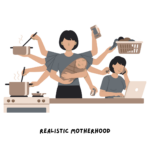
You are lying in bed, finally still, finally quiet, and your brain will not stop. It is running through tomorrow’s packed lunch, the permission slip that needs signing, the dentist appointment you keep forgetting to book. Or small things like the fact that you used the last of the olive oil and nobody else noticed. You even remembered the school project due Friday that your child mentioned for the first time tonight, the birthday party on Saturday that requires a present. Of course, there is the paediatrician follow-up, the dry cleaning, and the dog’s flea treatment that was due last week. Now this is the mental load of motherhood, aka the invisible burden we carry all day.

Nobody asked you to think about these things. Nobody assigned them to you in a meeting. They simply live in your head. Somehow, they always end up there because you are the one who notices.
This is the invisible burden, known as the mental load of motherhood. And it is exhausting in a way that sleep alone cannot fix.
What Is the Invisible Mental Load of Motherhood?
The mental load of motherhood is not the doing of household tasks. It is the managing of them: the noticing, the planning, the anticipating, the organising, the remembering, the deciding. Put simply, it is everything in between tasks. It is the cognitive and emotional labour that runs constantly in the background of a mother’s mind. It is invisible to almost everyone around her, including, often, her partner.
Doing the laundry is a task. Noticing the laundry needs doing and knowing which clothes belong to which child is one thing. But remembering that one needs a specific top clean for Wednesday’s school photo is an invisible load. Tracking the detergent levels, deciding when to run the machine — that is the mental load. And it never, ever stops.
The distinction matters because it explains something that many tired mothers struggle to articulate. Specifically, why are they exhausted even when other people are “helping”. Help with the doing is not the same as sharing the management. When a partner does the dishes after being asked, they have completed a task. The noticing, the asking, the follow-up — that still happened inside your head. That weight is still yours.
The Invisible Burden of Moms
Even in households where domestic tasks are divided relatively equally, the mental load remains overwhelmingly carried by mothers. A 2023 study published in the journal Sex Roles found that mothers reported significantly higher levels of cognitive household labour than fathers (1). And crucially, that this disparity was largely invisible to their partners, who tended to underestimate both the volume and the impact of this work.
This invisibility is at the core of why the mental load is so corrosive. It is not just tiring — it is isolating. To carry something heavy that nobody else can see is a particular kind of loneliness. It breeds resentment without a clear target and creates a low-grade anxiety that doesn’t have an obvious source because the source is everything, all at once, all the time.
And it doesn’t improve as children grow. The content shifts — from feeding schedules and nap routines to homework deadlines and friendship dramas and school applications — but the volume, for the default parent, rarely decreases.
The Mental Load of Being The Default Parent
The default parent is the one the children, the school, the paediatrician, the sports coach, and the birthday party host assume is the first point of contact for everything.
The default parent is the one the child calls for in the night, and the one the teacher emails. You know you are the default parent because you are the one the other parents message about the WhatsApp group for the class trip. Miriver, you know the names of all the children’s friends, their allergies, their teachers, their shoe sizes, their current obsessions, and which of them is going through a difficult phase.
Being the default parent is not simply a matter of availability. Many working mothers are still the default parent. It is a role assigned by assumption — by cultural expectation, by historical precedent, by the fact that it was always you who picked up first, so now it is always you.
Moreover, it is also a role that compounds. Every time a mother handles something because it is faster, easier, or less exhausting than explaining it to someone else, she reinforces the system that made her the default in the first place. But this is not her fault. It is a trap built into the structure of how most households still operate.
Food: The Never-Ending Cognitive Kitchen
Perhaps nowhere is the mental load more relentless than in the domain of food. I literally stress sometimes about what to cook, how to make my girls eat more vegetables, etc…
Think about what feeding a family actually involves, beyond the cooking itself. It means there is always someone who has to know what everyone will and won’t eat. And that someone is mostly the moms, the ones who have to notice when staples run low or have to plan what the family will eat across the week, cross-reference it with what’s already in the fridge, write the shopping list, do the shopping, put the shopping away, and then — only then — actually cook the meal.
And then do it again 2 days later.
Meal planning and grocery shopping are tasks that never conclude. The question of what’s for dinner reappears at 5 pm, along with the reliability of gravity. For a mother who is already depleted — whose nervous system is already running on too little rest, too much demand, and not enough of the nourishing food she keeps cooking for everyone else — this is not a small thing.
The answer is not simply to plan better or batch cook more efficiently, but rather to share the cognitive architecture of feeding the family — not just the stirring and the chopping, but the knowing, the planning, the deciding. That is where the weight lives.

Beyond food, there is the ongoing management of a home that is simultaneously lived in by small people who generate chaos and need to be functional for everyone inside it.
Cleaning is one task. But managing cleanliness — noticing the bathroom needs attention before it becomes a crisis, knowing when the sheets were last changed, tracking what’s run out, organising the cleaning supplies, scheduling the tasks across the week so nothing is ever catastrophically neglected — that is a separate and permanent cognitive project.
Packing is one of the most underrated entries in the mental load catalogue. School bags, sports bags, swimming bags, sleepover bags, hospital bags for the paediatrician visit, and the bag for the weekend at grandma’s. Someone has to know what goes in each one, what was left behind last time, what the child will need and forget they need. That person, in most households, is the mother.
And of course, here comes the mess. The relentless, regenerating mess of a family home. It is not simply that things are untidy — it is that the untidiness is noticed, processed, and either acted upon or mentally filed for later by the same person, every time. The cognitive cost of living in a perpetually messy environment is real and measurable: clutter raises cortisol, visual disorder competes for attention, and the background hum of things that need doing is a genuine drain on mental and emotional resources.
None of this is dramatic. The mental load of motherhood is not made of emergencies, but rather of a thousand small, ordinary, invisible things that add up to something very heavy indeed.
However, make sure you learn to simplify a lot of things and tasks in your life and be realistic with your motherhood journey.
You Are Not Imagining It
If you have read this far and felt seen, and also slightly tearful, and also quietly furious — that is the appropriate response.
You are not disorganised and not bad at coping. You are not too sensitive or too easily overwhelmed. Listen to me, you are carrying something real that costs you more than anyone around you understands.
The exhaustion you feel at the end of a day is real. When you “didn’t really do that much” is the exhaustion of a brain that has been managing everything else. Anticipating, tracking, and organising from the moment it woke up is real work too.
Now, the first step — always, but always — is making the invisible visible. Name it, out loud, to your partner, to yourself, to your nanny or somebody you can relate to. But not as a complaint, only as information, so they know the truth of what your days actually contain.
A Book Worth Reading
If any of this has resonated with you — and I suspect it has if you’re here — there is one book I want to put in your hands.
Releasing the Mother Load by Erica Djossa is, in the most generous sense, a permission slip. Erica is a psychotherapist and mother who has spent her career working with mothers on exactly this: the invisible weight, the default parent dynamic, the resentment that builds in its silence, and — crucially — the practical, relationship-grounded ways to begin to release it.
This is not a book that tells you to do less or lower your standards. It will help you understand why you carry what you carry, and gives you help. It is written by a tired mom, so is compassionate, clear, and profoundly validating. Erica genuinely understands what the experience can be.
If you are trying to ask for help from your partner or trying to figure out what’s wrong, read it. You will know why you’re so tired, why “helping out” doesn’t fix the thing you can’t quite name.
This book is, without question, one of the most useful things a tired, overwhelmed mother can read.
I hope you understood what the invisible burden of motherhood is. And I hope you know you are doing everything well. You are a good and loving mom.