With Love, Katie.


Motherhood today often feels like a constant movement from one task to the next. There are meals to prepare, laundry to fold, messages to answer, and children who need attention, comfort, and guidance. Many mothers move through their days multitasking without pause, carrying not only physical responsibilities but also the invisible mental load of planning, remembering, and anticipating. And this is exactly what a healthy dolce far niente lifestyle will learn us not to do.
In a world that values productivity and efficiency, slowing down can feel almost impossible. Rest can feel undeserved. Even moments of quiet are often filled with scrolling, catching up on tasks, or mentally reviewing everything that still needs to be done.
But what if motherhood also needed something else? Something quieter and gentler.
This is where the idea of Healthy Dolce Far Niente comes in: a philosophy that invites mothers to rediscover the sweetness of doing nothing, not as laziness, but as an essential part of a balanced life.
What Is Healthy Dolce Far Niente?
The phrase “dolce far niente” comes from Italian culture and literally translates to “the sweetness of doing nothing.” Traditionally, it refers to the simple pleasure of being present without feeling the need to produce, achieve, or rush.
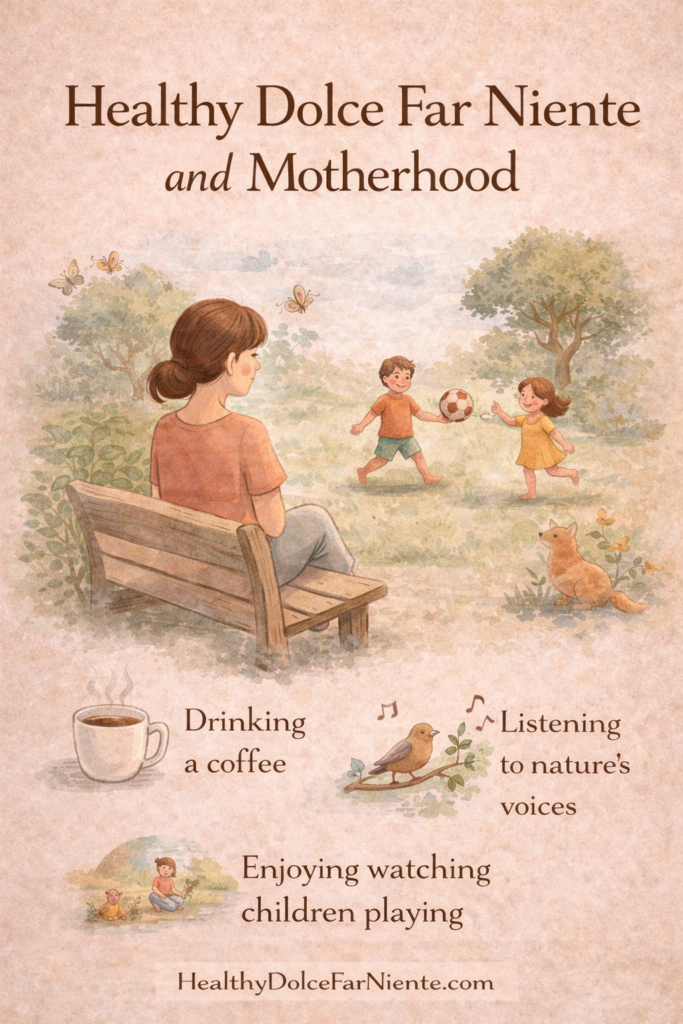
Imagine sitting outside with a warm cup of coffee while the sun rises. Watching your children play in the garden without checking your phone. Taking a slow walk simply because the air feels good.
These moments might seem small, but they carry something powerful: presence.
Healthy Dolce Far Niente takes this traditional idea and expands it into a modern philosophy of well-being. It recognizes that true rest is not the same as distraction or exhaustion. Real rest allows the body and mind to recover.
Healthy Dolce Far Niente means creating intentional pauses in daily life, moments where you allow yourself to simply exist without pressure.
It is not about ignoring responsibilities, but more about balancing them with moments that restore energy, calm the nervous system, and reconnect you with the present moment.
Why Does Motherhood Make Rest So Difficult?
For many mothers, doing nothing can feel uncomfortable or even wrong. Modern motherhood often carries an unspoken expectation: you should always be doing something.
Cooking, organizing, working, planning, learning, improving, helping, solving.
Even during so-called “rest time,” many mothers remain mentally active. The brain continues to process tomorrow’s schedule, unfinished tasks, or worries about family needs.
This constant activity is partly due to the invisible load of motherhood—the mental and emotional labor that often goes unnoticed. Mothers frequently carry the responsibility of remembering appointments, preparing meals, organizing routines, and anticipating problems before they arise.
In addition, modern life introduces another challenge: constant stimulation. Smartphones, social media, notifications, and digital distractions rarely allow the brain to fully relax.
As a result, many mothers experience a state that scientists sometimes describe as “wired but exhausted.” The body feels tired, yet the nervous system remains alert.
Healthy Dolce Far Niente offers a gentle antidote to this state.
How Does Motherhood Fit With This Lifestyle?
At first glance, the idea of “doing nothing” may seem incompatible with motherhood. Children bring noise, unpredictability, and constant needs. Life with young children rarely offers long stretches of quiet.
But Healthy Dolce Far Niente is not about escaping motherhood. Instead, it is about changing how we experience small moments within it.
Motherhood already contains countless opportunities for presence: if we allow ourselves to notice them.
Watching a toddler build something with blocks. Sitting beside a child while they draw. Listening to the sound of laughter in another room.
Often, these moments pass quickly because we are mentally somewhere else, already moving to the next task.
Healthy Dolce Far Niente invites mothers to pause inside these moments rather than rushing through them.
It can look like:
- Sitting on a bench while your child plays at the playground (and enjoying the birds sound)
- Drinking tea slowly while the house is quiet (just wake up 10 minutes before your family wakes up)
- Standing by an open window for a few deep breaths (maybe you try the 3-3-3 rule of anxiety or a grounding technique to calm yourself)
- Letting a moment exist without immediately filling it with productivity
These pauses may only last a few minutes, but they allow the nervous system to shift out of constant alert mode.
Can Doing Nothing Actually Support Emotional Resilience?
Many mothers worry that slowing down will make them less productive or organized. In reality, the opposite is often true.
Our brains and bodies are designed to move between activity and rest. When we remain in constant “doing mode,” stress hormones such as cortisol remain elevated. Over time, this can lead to irritability, fatigue, and anxiety.
Moments of stillness activate the parasympathetic nervous system, often called the “rest and digest” state. This state allows the body to recover, regulate emotions, and restore energy.
Healthy Dolce Far Niente, therefore, becomes a powerful tool for emotional resilience. Instead of pushing through exhaustion, mothers learn to create small spaces of recovery throughout the day. Listen, I am talking about 1-2 minute pauses that will support you through a hard day. These moments do not require a spa day or a perfectly quiet house.
What Does Healthy Dolce Far Niente Look Like in Everyday Life?
Healthy Dolce Far Niente does not require major lifestyle changes. It often begins with small shifts in awareness. Here are a few examples of how mothers can practice it naturally:
A Morning Pause
Instead of immediately reaching for your phone, take a moment to sit with a warm drink. Notice the quiet of the early morning. Even two minutes of stillness can set a calmer tone for the day.
Watching Instead of Managing
When children are playing safely, resist the urge to tidy, organize, or multitask. Sit nearby and simply observe. These moments often pass quickly as children grow.
Stepping Outside
Fresh air has a powerful effect on the nervous system. Standing outside for a few minutes, feeling the sunlight or wind, can create a small but meaningful reset.
Ending the Day Gently
After bedtime routines, instead of immediately returning to tasks or screens, allow yourself a brief moment of stillness. A cup of tea, soft lighting, or quiet reflection can signal to the body that the day is winding down.
These small rituals create islands of calm inside a busy life.
Are We Teaching Our Children Something Important?
Interestingly, practicing Healthy Dolce Far Niente not only benefits mothers. It also shapes how children understand rest. When children grow up in environments where adults are constantly rushing, they may learn that being busy is the only acceptable state. They may struggle to relax or simply enjoy quiet moments.
But when children see a parent sitting peacefully, watching clouds, reading slowly, or enjoying a calm moment, they learn something else: that life includes space for stillness.
Children naturally understand the joy of doing nothing. They can spend long stretches exploring a stick, watching ants, or daydreaming. Healthy Dolce Far Niente allows mothers to reconnect with that same simple presence.
Why Multitasking Is Not Supportive for Already Tired Moms
In modern motherhood, multitasking often feels like a survival skill. Cooking while answering messages or listening to your favourite podcast, thinking about tomorrow’s schedule while playing with your child, or trying to “rest” while scrolling and mentally planning the day. However, neuroscience tells us something very important:
Multitasking is not helping your brain—it is exhausting it.
From a brain perspective, true multitasking does not actually exist. What we call multitasking is usually rapid task-switching, where the brain shifts attention from one task to another. Each switch comes with a cognitive cost—a small but significant energy demand on the brain (1).
Over time, these small costs add up. Research shows that multitasking can impair memory, focus, and decision-making, while also increasing cognitive load and reducing performance.
In fact, studies suggest that switching between tasks can reduce productivity by up to 40% due to the mental effort required to refocus (2), and what’s more, it increases stress with time.
But for mothers, the impact goes even deeper.
Multitasking is also linked to increased stress levels and reduced well-being (3).
When the brain is constantly switching tasks, it keeps the nervous system in a more activated state, which can elevate cortisol—the body’s primary stress hormone. Over time, this can contribute to feelings of irritability, mental fatigue, overwhelm, and difficulty relaxing.
From a neuroscientific perspective, multitasking also increases cognitive load, meaning the brain has to work harder while actually performing worse.
Is multitasking real?
Now you are asking: Is multitasking real? Put simply, when you are so-called “multitasking”, your brain actually switches quickly from one task to another rapidly. For an already tired mother—especially one experiencing sleep deprivation, hormonal fluctuations, and the invisible mental load—this creates a cycle: more multitasking → more stress → less clarity → more exhaustion.
This is exactly the opposite of what your nervous system needs.
Is multitasking bad for us?
Well, as a neuroscientist mom, let me share my honest opinion: multitasking isn’t good for anyone. What we often call “multitasking” is actually just rapid task-switching—and your brain pays a price for it every single time. Each switch increases your cognitive load, meaning your brain has to work harder to refocus, reorganize, and keep track of what you were doing before.
And that extra effort? It’s exhausting. You might feel like you’re being productive: answering messages while making breakfast, tidying up while thinking about your to-do list, but in reality, you’re draining your mental energy much faster than if you focused on one thing at a time.
Over time, this constant switching can lead to increased fatigue, reduced concentration, and even more stress. As a mom, you’re already carrying a full mental load, your brain doesn’t need the extra pressure.
Slowing down and doing one thing at a time isn’t laziness—it’s actually more aligned with how your brain is designed to function.
Why This Matters for Healthy Dolce Far Niente?
The philosophy of Healthy Dolce Far Niente is rooted in presence, calm, and nervous system regulation. Multitasking pulls you in the opposite direction.
Instead of allowing the brain to enter a rest-and-digest state, multitasking keeps it in a subtle but constant state of alertness. This prevents true rest, even during moments that are supposed to feel calm.
In contrast, focusing on one task at a time, whether it is preparing a meal, sitting with your child, or simply drinking your coffee/matcha allows the brain to:
-
reduce cognitive load
-
lower stress signals
-
improve emotional regulation
-
restore mental energy (4)
From both a scientific and practical perspective, the shift is simple but powerful:
Doing one thing at a time is not less productive—it is more supportive for your brain, your hormones, and your overall well-being.
And for mothers, this is not about doing less. It is about creating small moments of presence in a life that already asks a lot.
Does Motherhood Need More Dolce Far Niente?
In many ways, modern motherhood has become more complex and demanding than ever before. Technology, social expectations, and the pressure to “do everything well” often leave mothers feeling overwhelmed.
Yet human needs have not changed. The body still requires rest. The mind still benefits from quiet.
Healthy Dolce Far Niente reminds us that motherhood does not have to be lived entirely at full speed.
It is possible to nurture children, manage responsibilities, and still allow moments of sweetness in everyday life.
Sometimes those moments are as simple as sitting quietly while sunlight enters the room, listening to children laugh in the distance, and allowing yourself to breathe.
A Gentler Way to Mother
Healthy Dolce Far Niente is not about becoming a perfect, calm, slow-living mother. Real life will always include chaos, busy days, and moments of exhaustion. Instead, it is about remembering that within the movement of motherhood, there can also be stillness.